
Motley Projected and Actual Release
TDCJ uses “Projected Release Date” as a specific public field. Classification and Records calculates it from the offense date, offense type, sentence, credit rules, and current record. It is forward-looking. A later “Scheduled Release date” appears after the release process has advanced and a release certificate reaches the calculation stage. The actual release is the completed custody exit recorded by TDCJ or another custodian.
These labels cannot be swapped. A projected date may correspond to a possible mandatory-supervision release or to discharge, depending on eligibility and the law that applies. A scheduled date is closer to operational release, yet it can still change. The actual event may be parole, mandatory supervision, full discharge, or transfer to another authority. Each result carries a different meaning.
A pretrial detainee usually has no computed release date. Bond can authorize release, but it does not prove that bond was posted or that all holds cleared. A dismissal can remove one basis for custody while another warrant remains. In that setting, the court order and the jail’s book-out disposition are stronger than an estimated date.
Choose Motley Release Date Custodian
Motley County’s boarding model makes custody identification the first step. The official county site does not establish a full-service local jail, and Texas jail reports show Motley prisoners housed elsewhere. The Motley County Sheriff must identify the physical receiving jail for the booking in question. A book-out from that jail may mean community release, return to Motley, transfer to TDCJ, or handoff on another hold.
| Custody path | Date source | What to confirm |
|---|---|---|
| Motley or receiving county jail | Sheriff, receiving jail, and court | Book-out time, disposition, destination, bond or sentence authority, and holds |
| TDCJ state custody | TDCJ search, email response, Board data, and IVSS | Projected date, scheduled date, actual release event, and supervision type |
| Federal prison | BOP locator and federal docket | BOP release date and whether supervision or another custody system follows |
| ICE custody | ICE locator and ERO | Release, transfer, removal, or handoff to another authority |
Do not apply TDCJ good-time rules to a county sentence. The research found no official local county good-time policy for Motley. Ask the jail or sheriff for the existing calculation record and use the judgment for sentence length and jail credit. If the person moved to TDCJ, county disappearance marks a transfer, not a community release.
Find a Motley Projected Date
Use a unique identifier whenever possible. The Texas SID and seven-digit TDCJ number are far safer than a name alone. If only a name is known, compare the middle name, age or birth date, conviction county, offense, and case dates. A Motley booking number is not a TDCJ number, and a federal register number belongs to a different system.
- Establish present custody. Ask the Motley sheriff which jail or agency holds the person. If TDCJ received the person, allow for the state system’s working-day data lag.
- Search the state record. Enter the name, TDCJ number, or SID in the TDCJ inmate search. Review location, offenses, projected release date, and parole fields together.
- Use the email fallback. The TDCJ inmate-information request accepts a full name plus TDCJ number, or exact birth date or approximate age and conviction county when the number is unavailable.
- Interpret Board status. If a parole code appears, check the official vote key. Approval may name a future date or program.
- Confirm the event. Check IVSS or call Review and Release Processing when the scheduled date approaches. Preserve the official response or event record.
TDCJ provides working-day information and notes that online data are at least a day old. Its email route can provide current location, convictions, prior and present incarceration history, and a projected date. It does not supply photographs or Social Security numbers. Ask directly for historical release or discharge information if a former prisoner no longer appears in the public interface.
The official TDCJ email-request page shows the state’s fallback when the public lookup does not answer the date question.
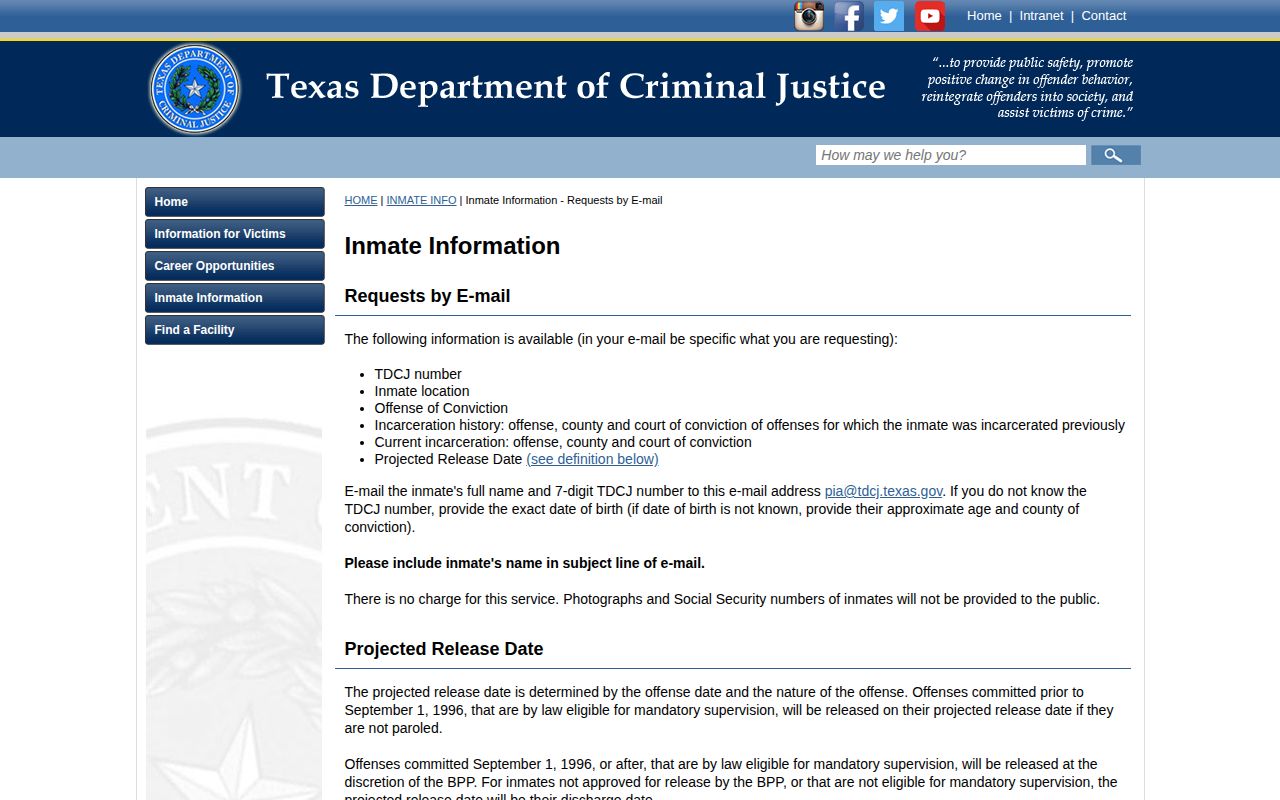
The captured page supports a direct state request; it does not turn a projected date into proof of actual release.
The Motley County released-inmate lookup covers the separate county record path when the person never entered TDCJ. A no-result in either system is not proof that release occurred.
Motley Good-Time Date Rules
Texas Government Code Chapter 498 governs state good-conduct time. Good time affects eligibility for parole or mandatory supervision. It does not reduce the sentence imposed by the court. It is a privilege tied to conduct and participation, may be forfeited, and may be restored under agency rules. The statute permits up to fifteen added days for each thirty days actually served for qualifying diligent participation, but “may” is the key word. No public calculator can promise the credit.
For a mandatory-supervision-eligible offense committed before September 1, 1996, TDCJ explains that the projected date may be the scheduled mandatory-supervision date if parole does not occur first, when flat time plus good time reaches the sentence. For later eligible offenses, the Board can deny mandatory supervision on statutory findings. If the person is not eligible or not approved, the projected field generally points toward discharge unless another lawful change intervenes.
Parole eligibility has its own rules in Government Code Chapter 508. The broad ordinary formula uses calendar time plus good time equal to one-fourth of the sentence or fifteen years, whichever is less. Listed serious offenses and deadly-weapon cases generally require actual calendar time equal to half the sentence or thirty years, whichever is less, with a two-year minimum. Specialized categories and the law in effect on the offense date can change the result.
Texas therefore has no blanket rule that every prisoner serves 85 percent. The old “3g” label refers to a repealed provision and should be treated as historical shorthand. Current work must check the applicable version of Section 508.145 and, where relevant, the successor list in Code of Criminal Procedure Chapter 42A.
Note: Eligibility allows review; it does not guarantee approval, complete release processing, or departure from the holding facility on that date.
Why Motley Release Dates Change
A projected date is recalculated when the facts that support it change. Some changes move the date. Others change the kind of event expected. TDCJ Classification and Records remains the proper source for the official state calculation, while the court controls sentence orders and the Board controls parole decisions.
| Factor | Possible effect | Best evidence |
|---|---|---|
| Good-time award, loss, or restoration | Changes eligibility math where credits apply | TDCJ calculation or history under Chapter 498 |
| Board vote or prerequisite program | Creates, delays, or conditions a parole path | Full vote code and official interpretation |
| Mandatory-supervision decision | Allows or denies the statutory release route | Board decision and TDCJ status |
| New judgment or sentence recalculation | Changes the term, credit, or sequence of sentences | Signed court order and TDCJ audit |
| Disciplinary action | May forfeit good time or affect processing | Official disciplinary and calculation record |
| Detainer or warrant | May cause transfer rather than community release | Custody disposition naming the receiving authority |
| Release certificate and file audit | Moves the record from projected toward scheduled | TDCJ release-processing confirmation |
A one-day mismatch does not necessarily signal an error. A booking may cross midnight, a court may sign before the jail finishes book-out, and TDCJ data may post after the operational event. Record the source date, timestamp, and time zone. If only a date is published, do not invent a time.
When the math seems wrong, request the existing calculation instead of reverse-engineering it. Ask whether jail credit, concurrent or consecutive sentences, a hold, discipline, or a later court order affected the date. The Public Information Act grants access to existing public information but does not require an agency to create a new explanation or report.
Motley Scheduled Release Audit
TDCJ’s Ombudsman material describes a later operational phase. After a release certificate is received, Classification and Records audits the file and calculates a “Scheduled Release date” and “Scheduled Release location.” The stated calculation interval is about fourteen to twenty-one business days. That interval is not a promise of release within that span. It describes the audit after the process has reached that point.
Holds, detainers, sentence changes, required programs, discipline, or new information can alter the outcome. The scheduled location also matters because no TDCJ unit is in Motley County. “Motley County inmate” may refer to conviction county or intended residence rather than the place of physical release. Contact the named unit or TDCJ before pickup and confirm both date and location.
The public search may show projected information before a scheduled event exists. A family should not make travel plans from the projected field alone. Review and Release Processing can be reached at 512-406-5202 for an advanced state-release question. Ask a narrow question tied to the TDCJ number and current record.
Confirm Motley Actual Release Dates
IVSS can add an event and notification layer for state custody. A person may search by name, SID, current TDCJ number, or previous number, then inspect the details and subscribe. Events may include parole eligibility, Board decisions, prison release, and discharge. Registration information is confidential. A notification is still a lead, so pair it with the TDCJ record when exact proof matters.
County VINE and TDCJ IVSS are separate systems. If a county subject transfers to TDCJ, a separate IVSS registration is needed. Motley participation in county VINE was not established by the official county sources. The Motley VINE inmate check explains how to verify live coverage and avoid treating a transfer alert as community release.
For a reported parole release, capture the full decision code, check for a required program or future date, and then seek the actual TDCJ event or certificate. For full discharge, request the actual discharge date and status rather than using an old projection. For a county sentence, pair the judgment and credited time with the receiving jail’s book-out transaction.
Exact words protect accuracy. Say “projected,” “scheduled,” or “actual” according to the source. Say “transferred” when another agency took custody. Use “released on parole,” “released to mandatory supervision,” or “sentence discharged” only when the official evidence supports that result.
Public Record Search
Sponsored Results